<?xml version="1.0" encoding="utf-8"?><feed xmlns="http://www.w3.org/2005/Atom" ><generator uri="https://jekyllrb.com/" version="3.10.0">Jekyll</generator><link href="https://orthic.shorthand.fun/feed.xml" rel="self" type="application/atom+xml" /><link href="https://orthic.shorthand.fun/" rel="alternate" type="text/html" /><updated>2026-02-20T22:29:42-05:00</updated><id>https://orthic.shorthand.fun/feed.xml</id><title type="html">Orthic Shorthand</title><subtitle>Double your handwriting speed with this no-nonsense shorthand system.</subtitle><entry><title type="html">New Introductory Course</title><link href="https://orthic.shorthand.fun/new-intro-course" rel="alternate" type="text/html" title="New Introductory Course" /><published>2025-08-15T17:49:19-04:00</published><updated>2025-08-15T17:49:19-04:00</updated><id>https://orthic.shorthand.fun/new-intro-course</id><content type="html" xml:base="https://orthic.shorthand.fun/new-intro-course"><![CDATA[<p>Mutsumi has published <a href="https://mutsumino.neocities.org/scripts/orthic"><em>An Introduction to Orthic</em></a> to teach the fully-written style from start to finish in a more modern fashion with exercises. The site looks good on mobile, and a PDF is available for printing or offline reference.</p>]]></content><author><name>Jeremy</name></author><category term="news" /><summary type="html"><![CDATA[Mutsumi has published An Introduction to Orthic to teach the fully-written style from start to finish in a more modern fashion with exercises. The site looks good on mobile, and a PDF is available for printing or offline reference.]]></summary></entry><entry><title type="html">Teaching Of Transcriptions Now in Navbar</title><link href="https://orthic.shorthand.fun/teaching-transcriptions" rel="alternate" type="text/html" title="Teaching Of Transcriptions Now in Navbar" /><published>2022-12-17T15:27:19-05:00</published><updated>2022-12-17T15:27:19-05:00</updated><id>https://orthic.shorthand.fun/teaching-transcriptions</id><content type="html" xml:base="https://orthic.shorthand.fun/teaching-transcriptions"><![CDATA[<p>Thanks to the work of Jacob Moena, the Orthic community benefits from clean transcripts of the two <em>Teaching of Orthic Shorthand</em> volumes. These transcriptions were finished in September 2022, and they now receive pride of place alongside the Manual and Supplement in the site navigation, under the new “Teaching” item.</p>

<p>Start reading now at:</p>

<ul>
  <li><a href="https://orthic.shorthand.fun/teaching-pt1">Part 1</a></li>
  <li><a href="https://orthic.shorthand.fun/teaching-pt2">Part 2</a></li>
</ul>]]></content><author><name>Jeremy</name></author><category term="news" /><summary type="html"><![CDATA[Thanks to the work of Jacob Moena, the Orthic community benefits from clean transcripts of the two Teaching of Orthic Shorthand volumes. These transcriptions were finished in September 2022, and they now receive pride of place alongside the Manual and Supplement in the site navigation, under the new “Teaching” item.]]></summary></entry><entry><title type="html">Reporting Psalms PDF Now Available</title><link href="https://orthic.shorthand.fun/reporting-psalms" rel="alternate" type="text/html" title="Reporting Psalms PDF Now Available" /><published>2022-06-15T07:11:23-04:00</published><updated>2022-06-15T07:11:23-04:00</updated><id>https://orthic.shorthand.fun/reporting-psalms</id><content type="html" xml:base="https://orthic.shorthand.fun/reporting-psalms"><![CDATA[<p>The final reading pamphlet for the Teaching course, <a href="https://orthic.shorthand.fun/assets/reading/Orthic Psalms 66-83 (Reporting Style) 1897 Stevens.pdf">Psalms 66–83 in reporting style</a>, is now available to accompany the second volume of <em>The Teaching of Orthic Shorthand.</em> Many thanks to Reddit user u/brifoz for pointing the way towards this last, elusive book of readings!</p>

<p>If anyone has a lead on:</p>

<ul>
  <li>the list of recognized contractions issued by the Cambridge Shorthand Society or</li>
  <li>any editions of the Orthic Monthly magazine</li>
  <li>any examples of issued teaching diplomas or speed certificates</li>
  <li>a copy of the list of schools adopting Orthic shorthand that was once available upon request</li>
</ul>

<p>please do reach out!</p>]]></content><author><name>Jeremy</name></author><category term="news" /><summary type="html"><![CDATA[The final reading pamphlet for the Teaching course, Psalms 66–83 in reporting style, is now available to accompany the second volume of The Teaching of Orthic Shorthand. Many thanks to Reddit user u/brifoz for pointing the way towards this last, elusive book of readings!]]></summary></entry><entry><title type="html">Orthic Psalms PDFs Available</title><link href="https://orthic.shorthand.fun/psalms-pdfs" rel="alternate" type="text/html" title="Orthic Psalms PDFs Available" /><published>2022-03-24T23:35:46-04:00</published><updated>2022-03-24T23:35:46-04:00</updated><id>https://orthic.shorthand.fun/psalms-pdfs</id><content type="html" xml:base="https://orthic.shorthand.fun/psalms-pdfs"><![CDATA[<p>Stevens’ renderings of the Psalms, provided as study material to accompany Part 1 of <em>The Teaching of Orthic Shorthand</em>, are now available as three 17-page PDFs:</p>

<ul>
  <li><a href="https://orthic.shorthand.fun/assets/reading/Orthic Psalms 1-20 (Full Style) 1896 Stevens.pdf">Psalms 1-20 in full style</a> serves as both exercise book and exam for the completion of Lessons 1 through 3.</li>
  <li><a href="https://orthic.shorthand.fun/assets/reading/Orthic Psalms 21-39 (Ordinary Style) 1896 Stevens.pdf">Psalms 21-39 in ordinary style</a> serves likewise for Lessons 4 through 5.</li>
  <li><a href="https://orthic.shorthand.fun/assets/reading/Orthic Psalms 40-65 (Abbreviated Style) 1896 Stevens.pdf">Psalms 40-65 in abbreviated style</a> (also called <em>Supplement</em> style) serves likewise for Lessons 6 through 8, at which point you’re expected to be writing 60 WPM and reading fluently. (Lesson 9 is a capstone with some final guidance and a reminder to review  the list of recognized contractions issued by the Society, which list appears to be lost.)</li>
</ul>

<p>With these volumes, we now have in hand a complete course of study (using 19th Century pedagogy techniques, granted) used in practice to take students to fluency in non-reporting Orthic.</p>

<p>If anyone has a lead on the reporting-style Psalms volume, that list of contractions, or any editions of the Orthic Monthly magazine, please do reach out!</p>]]></content><author><name>Jeremy</name></author><category term="news" /><summary type="html"><![CDATA[Stevens’ renderings of the Psalms, provided as study material to accompany Part 1 of The Teaching of Orthic Shorthand, are now available as three 17-page PDFs:]]></summary></entry><entry><title type="html">‘Teaching of Orthic’ PDFs Available</title><link href="https://orthic.shorthand.fun/teaching-of-pdfs" rel="alternate" type="text/html" title="‘Teaching of Orthic’ PDFs Available" /><published>2022-03-07T19:29:39-05:00</published><updated>2022-03-07T19:29:39-05:00</updated><id>https://orthic.shorthand.fun/teaching-of-pdfs</id><content type="html" xml:base="https://orthic.shorthand.fun/teaching-of-pdfs"><![CDATA[<p>The two volumes of Stevens’ 1896 work <em>The Teaching of Orthic Shorthand</em> are now available as PDFs:</p>

<ul>
  <li><a href="https://orthic.shorthand.fun/assets/teaching/pt1/Teaching of Orthic Pt 1 1896 Stevens.pdf">Part 1</a> is 19 pages (including the front and back cover) and provides a series of 9 lessons for teaching the base system.</li>
  <li><a href="https://orthic.shorthand.fun/assets/teaching/pt2/Teaching of Orthic Pt 2 1896 Stevens.pdf">Part 2</a> extends the system by providing rules for reporting that build on the existing shortening techniques. It adds one character, a vertical bar for B, which is to be used only medially (so: not in bat, not in tab, yes in tabby). The file has 18 pages, again including the covers in that count.</li>
</ul>

<p>These were published 4 years after the <em>Supplement</em> and, I believe, complete the entire Orthic shorthand theory as developed by the Cambridge Shorthand Society.</p>]]></content><author><name>Jeremy</name></author><category term="news" /><summary type="html"><![CDATA[The two volumes of Stevens’ 1896 work The Teaching of Orthic Shorthand are now available as PDFs:]]></summary></entry><entry><title type="html">Dictionary Search Form</title><link href="https://orthic.shorthand.fun/searchable-dictionary" rel="alternate" type="text/html" title="Dictionary Search Form" /><published>2021-09-10T11:03:32-04:00</published><updated>2021-09-10T11:03:32-04:00</updated><id>https://orthic.shorthand.fun/searchable-dictionary</id><content type="html" xml:base="https://orthic.shorthand.fun/searchable-dictionary"><![CDATA[<p>The <a href="/dictionary"><strong>Orthic Dictionary</strong></a> now sports a search form. Type in some letters, hit Search, and the dictionary entries will be filtered down to just the matching entries: those that contain the precise text you searched for. You can search either in the “plaintext” (the English word defined in the entry), or in the Orthic notation given under the entry. If you search Orthic notation, only the examples with notations (and the parent entry, of course) will show up.</p>

<p>While you could always use your browser’s built-in search feature,
this actually narrows what you see on the screen, so you can browse only matches,
and it ignores any matches elsewhere on the page: it’s a lot easier to <a href="/dictionary?q=the&amp;in=text#dictionary">search the dictionary for “the”</a> now!</p>

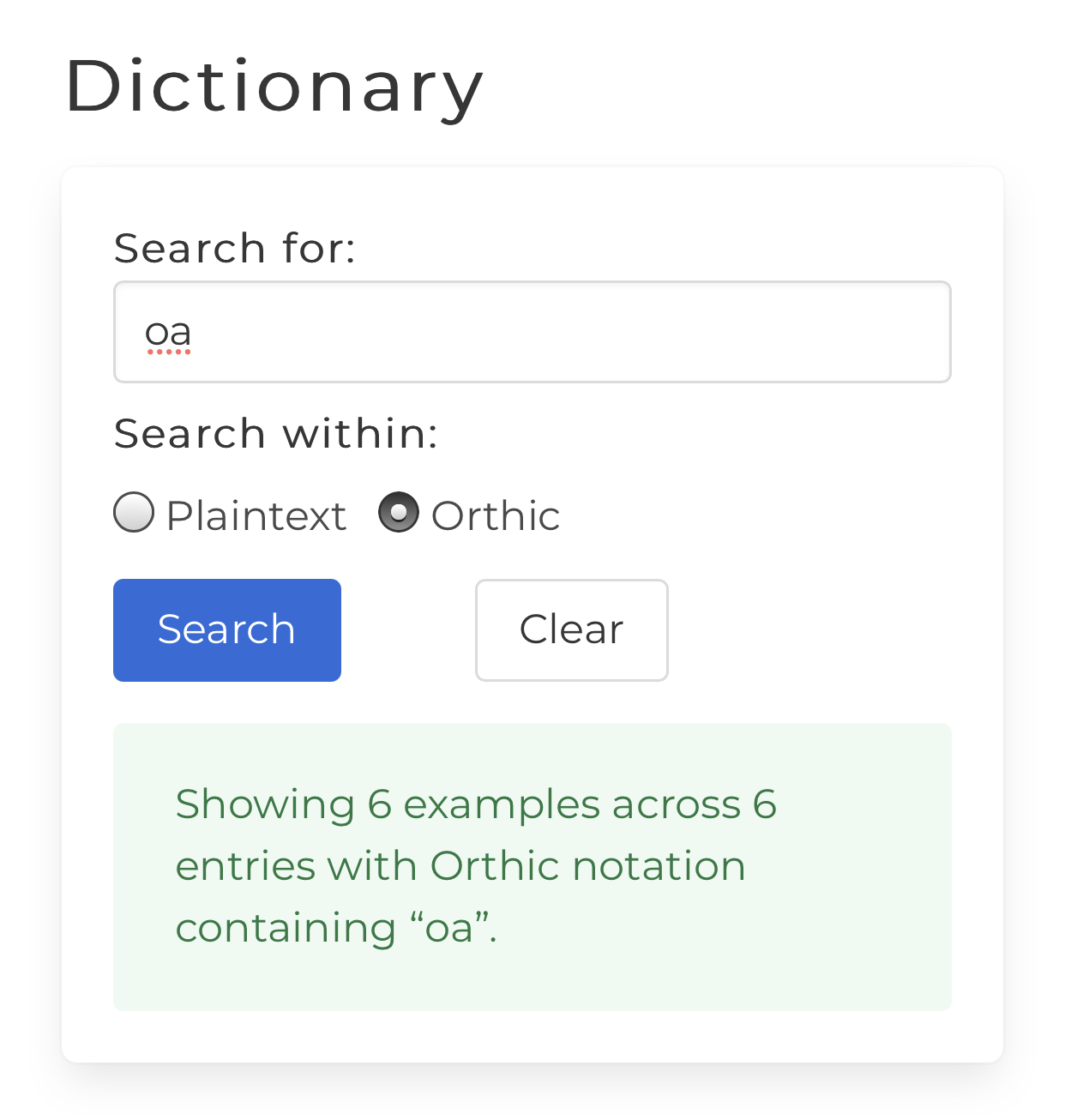
<p>I’m looking forward to using it to find examples of odd joins to review, such as <strong>how to write “oa”:
<a href="/dictionary?q=oa&amp;in=orthic#dictionary">https://orthic.shorthand.fun/dictionary?q=oa&amp;in=orthic#dictionary</a>.</strong>
(As you can see, the URL also updates to reflects the search terms: <code class="language-plaintext highlighter-rouge">q=oa</code> =&gt; search for <code class="language-plaintext highlighter-rouge">oa</code>, <code class="language-plaintext highlighter-rouge">in=orthic</code> within the Orthic.
This means you can share or bookmark your search results for later.)</p>

<figure>
  <img src="/assets/notes/search-dictionary-screenshot.png" title="" />
  <figcaption>Dictionary Search for `oa` within Orthic</figcaption>
</figure>]]></content><author><name>Jeremy</name></author><category term="news" /><summary type="html"><![CDATA[The Orthic Dictionary now sports a search form. Type in some letters, hit Search, and the dictionary entries will be filtered down to just the matching entries: those that contain the precise text you searched for. You can search either in the “plaintext” (the English word defined in the entry), or in the Orthic notation given under the entry. If you search Orthic notation, only the examples with notations (and the parent entry, of course) will show up.]]></summary><media:thumbnail xmlns:media="http://search.yahoo.com/mrss/" url="https://orthic.shorthand.fun/assets/notes/search-dictionary-screenshot.png" /><media:content medium="image" url="https://orthic.shorthand.fun/assets/notes/search-dictionary-screenshot.png" xmlns:media="http://search.yahoo.com/mrss/" /></entry><entry><title type="html">New: Reading Material</title><link href="https://orthic.shorthand.fun/new-readings-page" rel="alternate" type="text/html" title="New: Reading Material" /><published>2020-03-04T16:55:35-05:00</published><updated>2020-03-04T16:55:35-05:00</updated><id>https://orthic.shorthand.fun/new-readings-page</id><content type="html" xml:base="https://orthic.shorthand.fun/new-readings-page"><![CDATA[<p><a href="/reading">Check out our <strong>new Reading Material page!</strong></a>
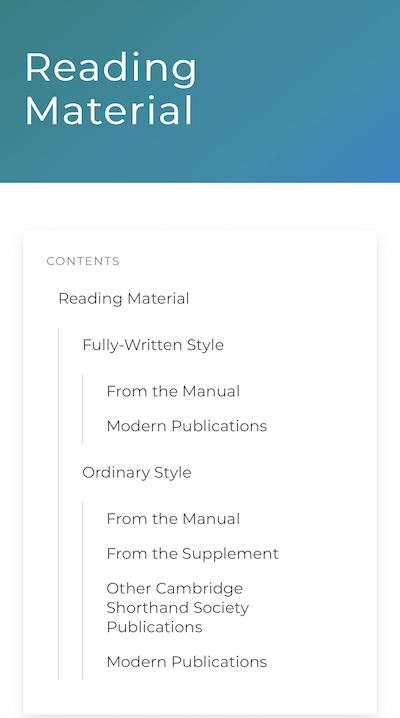
It’s now easier than ever to practice your reading by enjoying
some of <strong>Aesop’s fables</strong> written in the abbreviated style by Callendar
or <strong>“The Cask of Amontillado”</strong> written in the full style by Jeremy.
(You’ll also find the page in the Resources list in the menu at the
top of every page.)</p>

<p>In addition to those entertaining reads, you’ll find:</p>

<ul>
  <li>direct links to the English-language specimens from both Manual and Supplement</li>
  <li>a link to Stevens’ rendition of the New Testament</li>
</ul>

<p>Stevens’ writing is a goldmine of advanced abbreviating techniques.
(The text was apparently chosen due to ready availability of the key.
That has certainly proven a sound bet.)</p>

<p>Smaller changes:</p>

<ul>
  <li>The <strong>Supplement</strong> page now links to the <strong>Supplement source PDF</strong></li>
  <li>The <strong>Dictionary</strong> now includes <strong>all the Manual’s word and phrase images.</strong>
(Many of the entries still need some work, as evidenced by the frequency of “TODO” in the entries, but the images are there.)</li>
</ul>

<figure>
  <img src="/assets/notes/reading-toc-2020-03.jpg" title="" />
  <figcaption>Reading Material: Table of Contents</figcaption>
</figure>]]></content><author><name>Jeremy</name></author><category term="news" /><category term="study aids" /><summary type="html"><![CDATA[Check out our new Reading Material page! It’s now easier than ever to practice your reading by enjoying some of Aesop’s fables written in the abbreviated style by Callendar or “The Cask of Amontillado” written in the full style by Jeremy. (You’ll also find the page in the Resources list in the menu at the top of every page.)]]></summary><media:thumbnail xmlns:media="http://search.yahoo.com/mrss/" url="https://orthic.shorthand.fun/assets/notes/reading-toc-2020-03.jpg" /><media:content medium="image" url="https://orthic.shorthand.fun/assets/notes/reading-toc-2020-03.jpg" xmlns:media="http://search.yahoo.com/mrss/" /></entry><entry><title type="html">An Orthic dictionary takes shape</title><link href="https://orthic.shorthand.fun/dictionary-begun" rel="alternate" type="text/html" title="An Orthic dictionary takes shape" /><published>2020-02-07T21:55:35-05:00</published><updated>2020-02-07T21:55:35-05:00</updated><id>https://orthic.shorthand.fun/dictionary-begun</id><content type="html" xml:base="https://orthic.shorthand.fun/dictionary-begun"><![CDATA[<p><a href="/dictionary">Check out our new dictionary!</a>
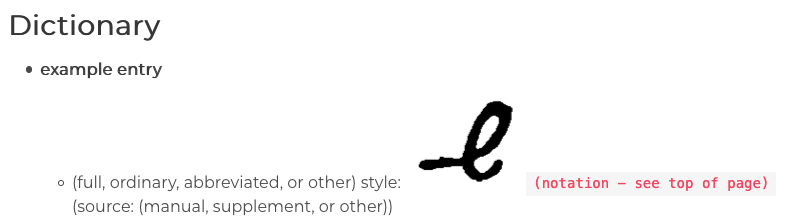
It features a notation to represent even abbreviated Orthic in ASCII,
so you can search for an outline in order to get the longhand English text.</p>

<p>The dictionary is also linked from the Resources list in the menu at the
top of every page.</p>

<p>To start with, it contains the briefs from the <em>Manual.</em>
Many of the resources are already in place to support this work,
thanks to the online <em>Manual</em> and <em>Supplement,</em>
but the raw materials need marshaling into shape to make up a dictionary.</p>

<p>Many thanks to <a href="https://www.reddit.com/user/CrBr">Redditor u/CrBr</a>
of the <a href="https://www.reddit.com/r/orthic">Orthic subreddit</a>
for their encouragement in finally starting this project.</p>

<figure>
  <img src="/assets/notes/dictionary - example entry.png" title="" />
  <figcaption>An example dictionary entry</figcaption>
</figure>]]></content><author><name>Jeremy</name></author><category term="news" /><category term="study aids" /><summary type="html"><![CDATA[Check out our new dictionary! It features a notation to represent even abbreviated Orthic in ASCII, so you can search for an outline in order to get the longhand English text.]]></summary><media:thumbnail xmlns:media="http://search.yahoo.com/mrss/" url="https://orthic.shorthand.fun/assets/notes/dictionary%20-%20example%20entry.png" /><media:content medium="image" url="https://orthic.shorthand.fun/assets/notes/dictionary%20-%20example%20entry.png" xmlns:media="http://search.yahoo.com/mrss/" /></entry><entry><title type="html">Easily link a brief</title><link href="https://orthic.shorthand.fun/linkable-briefs" rel="alternate" type="text/html" title="Easily link a brief" /><published>2020-01-20T20:34:35-05:00</published><updated>2020-01-20T20:34:35-05:00</updated><id>https://orthic.shorthand.fun/linkable-briefs</id><content type="html" xml:base="https://orthic.shorthand.fun/linkable-briefs"><![CDATA[<p>Helping fellow writers master Orthic’s shortcuts just got easier: The <em>Manual</em> now sports links for each brief, ending, and joining. The <em>Supplement</em> too now has links to each brief. (It already had links for its endings and beginnings, since they made it to the table of contents.)</p>

<p>The <a href="/manual#abbreviations-for-common-words">briefs</a> and <a href="/manual#abbreviate-common-endings">endings</a> are their own self-links, for easy copy-paste when talking about them with other writers. They also follow a predictable pattern in anchor naming, so that the brief for “down” is at <code class="language-plaintext highlighter-rouge">#down-brief</code> and the ending for “ward” is at <code class="language-plaintext highlighter-rouge">#ward-ending</code>.</p>

<p>The letters and significant joins have links collected at the top of the <a href="/manual#how-to-write-and-join-the-characters">“How to Write and Join the Characters”</a> section. These mostly follow the pattern set by “nsp” having the anchor <code class="language-plaintext highlighter-rouge">#nsp-join</code>, but some editorial decisions led to names like “U versus EE” (which gets <code class="language-plaintext highlighter-rouge">#u-versus-ee-join</code> as its anchor).</p>]]></content><author><name>Jeremy</name></author><category term="news" /><category term="study aids" /><summary type="html"><![CDATA[Helping fellow writers master Orthic’s shortcuts just got easier: The Manual now sports links for each brief, ending, and joining. The Supplement too now has links to each brief. (It already had links for its endings and beginnings, since they made it to the table of contents.)]]></summary></entry><entry><title type="html">Anki deck now available</title><link href="https://orthic.shorthand.fun/anki-deck-available" rel="alternate" type="text/html" title="Anki deck now available" /><published>2019-12-25T21:26:27-05:00</published><updated>2019-12-25T21:26:27-05:00</updated><id>https://orthic.shorthand.fun/anki-deck-available</id><content type="html" xml:base="https://orthic.shorthand.fun/anki-deck-available"><![CDATA[<p><a href="/assets/Shorthand__Orthic.apkg"><img src="/assets/notes/anki-review-screenshot.png" alt="Example of reviewing the word &quot;great&quot; in Anki v2.1.15 under macOS Mojave." /></a></p>

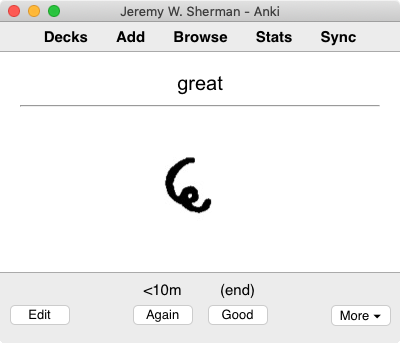
<p><strong><a href="/assets/Shorthand__Orthic.apkg">Download the Shorthand::Orthic Anki deck</a></strong> to study the briefs and affixes from both the <em>Manual</em> and the <em>Supplement.</em> This deck assumes you already have the basics of the alphabet down. (I don’t feel Anki is the best tool for learning a new alphabet, so I didn’t use it for that.)</p>

<p><a href="https://apps.ankiweb.net/">Anki</a> is a smart flashcard system: it tries to show you a card shortly before you’re likely to forget it, so that time spent reviewing is not wasted on cards you know through and through. When you first load in a bundle of cards, it can feel like a lot of reviews, but once you get through the deck, it settles down a lot. Don’t hesitate to throttle back the number of new cards and reviews to something you feel is manageable, or simply to just not do all the reviews if that’s what makes it workable for you. Coming back every day and spending five minutes quizzing yourself will slowly but steadily grow your vocabulary like magic.</p>]]></content><author><name>Jeremy</name></author><category term="news" /><category term="study aids" /><summary type="html"><![CDATA[]]></summary></entry></feed>